
Dear Visitor! We are carrying out maintenance this weekend, so our website may be slow or briefly unavailable at times. Thank you for your patience!
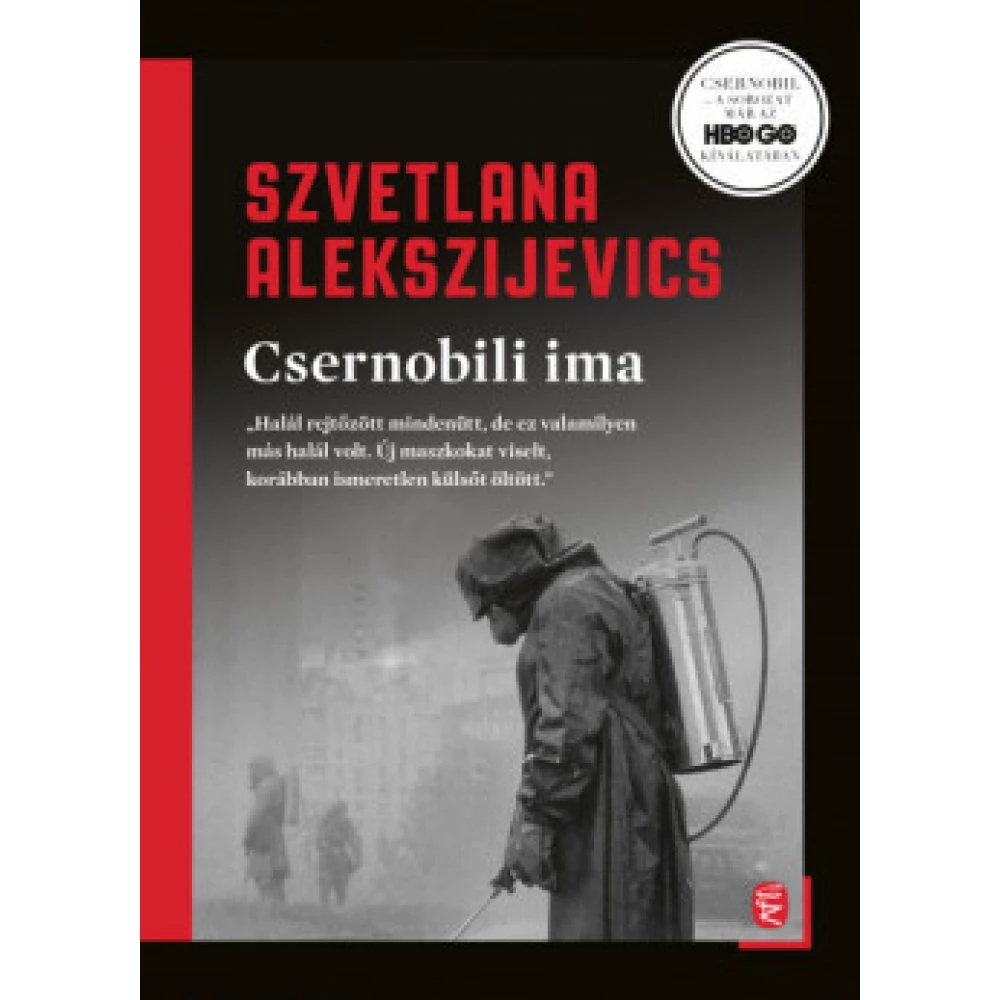
Szvetlana Alekszijevics - Csernobili ima (2020)
4 706 Ft
Product description
"Death was lurking everywhere, but this was a different kind of death. It wore new masks, took on a previously unknown appearance." "What is it - the past or the future?"
On April 26, 1986, the biggest nuclear power plant disaster of all time began in Chernobyl. Due to the secrecy of the Soviet leadership at the time, the world knew almost nothing about it for days...
The Nobel Prize-winning Belarusian writer dedicated two decades to working on the topic. He talked to people who were assigned to the scene immediately after the disaster and were given the most dangerous jobs. He spoke to the widows who were left with only their awards and diplomas. He talked to those who lived near the power plant, in Polezia, which became a peasant Atlantis - then their wells were boarded up and they were evicted, or they could stay in their houses, but after that they lived like the inhabitants of a reservation. We get to know the victims, those responsible, and the reckless volunteers immersed in Soviet virtue. We get to know those for whom Chernobyl is a philosophical problem, the founding myth of man after the atomic age, and those who blame the enemies of Soviet power, the West and traitors for it.
Chernobyl is not only an individual and family tragedy, but also a national tragedy. It is not a Soviet, not a Russian, nor a Ukrainian, but a Belarusian national tragedy. Out of a nation of ten million people, more than two million people live in polluted areas. Because when it was announced in the Soviet news channels as good news that fortunately the radioactive cloud did not fly towards Kiev, they did not announce that it covered Minsk and Belarus. Since the empire repeatedly stopped the process of becoming a nation here by force, many people only then realized that their fate was different, that they had to figure out how to save their lives. The nation living in colonial times entered world history with the Chernobyl disaster. Because the war in Afghanistan and the nuclear disaster also destroyed the empire.
Chernobyl marks an era for all actors. It means the loss of blissful ignorance, from which one can only reach resigned, bitter wisdom after a long time. Some have already reached this point, and some are just starting, like the village party secretary reading Solzhenitsyn. Some flee the zone, others are attracted to the area, which is slowly being reclaimed by nature.
Chernobyl was not only a disaster, but also a warning. And according to Aleksievich, every generation must read from the signs left for the future.
Chernobyl is still relevant today. And it will be relevant for another 48 thousand years.
Author: Svetlana Aleksievich
PRICE NOTIFICATION
NOTEBOOK SEARCH

OPINIONS
0.0
