
Dear Visitor! We are carrying out maintenance this weekend, so our website may be slow or briefly unavailable at times. Thank you for your patience!
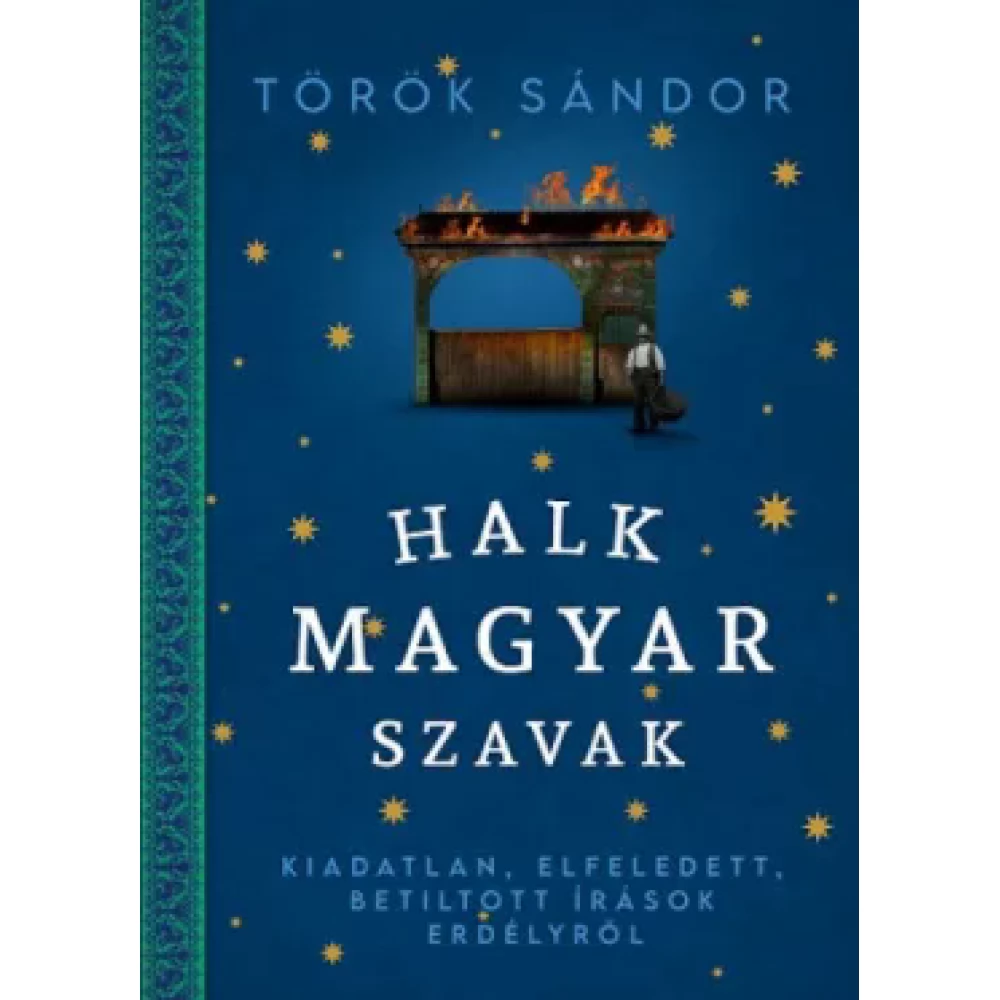
Török Sándor - Halk Hungarian words - Kiadatlan elfeledett betiltott írások Erdélyről
3 137 Ft
Product description
"And then something happened. Something that no one expected, that was surprising, like an arrow of God falling from the summer lamb cloud sky.
In Moldova, Gligor, the lawyer, stared straight ahead for a moment, then twitched his nose three times in quick succession, which was always a sign of strained brain work. He pushed away the plate with the silver paper cheese and raised his dessert knife high, throwing it in front of the police officer.
- What is this - shouted the lawyer - what is going on here? - He spoke Romanian. - In free Romania, everyone sings the notes they want and in the language they like!
Antal Gyerő looked at the lawyer. He didn't expect this.
No one expected this."
In the volume compiled by literary historian Tamás Bíró-Balogh, the reader can discover three banned and forgotten writings of Sándor Török, who was born in Transylvania and is today mainly known for his youth novels.
The writer, who moved to Hungary in the mid-20s, reports in the reportage novel Magyar fiúk oláh mundérban with subtle humor and readability about his still vivid experiences as a private in the Romanian royal army, and the absurd and inhuman operation of the army. Hungarian boys in Oláh uniforms first appeared in 1928, but were banned in 1945, and now appear only occasionally at auctions.
In the short novels Virradatvárók and Egy észelős ficó s ami ötötte akad, Török tells about the everyday life of the Transylvanian Hungarians and Romanians, their choices or even the impossibility of making a choice in times when reality and truth are easily superseded by a story made up of grotesque fictions, if the servants of the current power they wish it so. Copies of Egy észelős fíkó and what's around him, published in 1929, are now very rare, and they are not easy to find in public collections either. In 1928, Virradatváro was published in sequels by a newspaper, and then it was forgotten.
The volume concludes with a study by the historian János Főcze, which shows how the Kingdom of Romania was organized after the First World War, how the Hungarian society in Transylvania was restructured as a result of the changes, and what it meant and what challenges it entailed for the Transylvanian Hungarians that they had to continue in a new state. their lives.
SÁNDOR TÖRÖK (1904, Homoróddaróc - 1985, Budapest) completed his schooling in Brasov and Fogaras. At first, he lived by manual labor, passed the machine belt manufacturer's exam, and later worked as an actor in Cluj-Napoca. His particularly rich and varied career as a writer, translator, and editor began after he moved to Hungary. His early works were recognized in 1933 with the Baumgarten Prize. The popular author of novels and plays was elected to the Petőfi Society in 1938, but between 1940 and 1945 he was not allowed to publish due to his Jewish origin. As vice-president of the Union of Christian Jews, he delivered a copy of the Auschwitz Protocol to Governor Miklós Horthy. He was an active member of the anthroposophical circle led by Mária Göllner, a student of Rudolf Steiner, and worked until the end of his life to pass on the teachings of anthroposophy to others. In 1974, he received the József Attila Award.
PRICE NOTIFICATION
NOTEBOOK SEARCH

OPINIONS
0.0
