
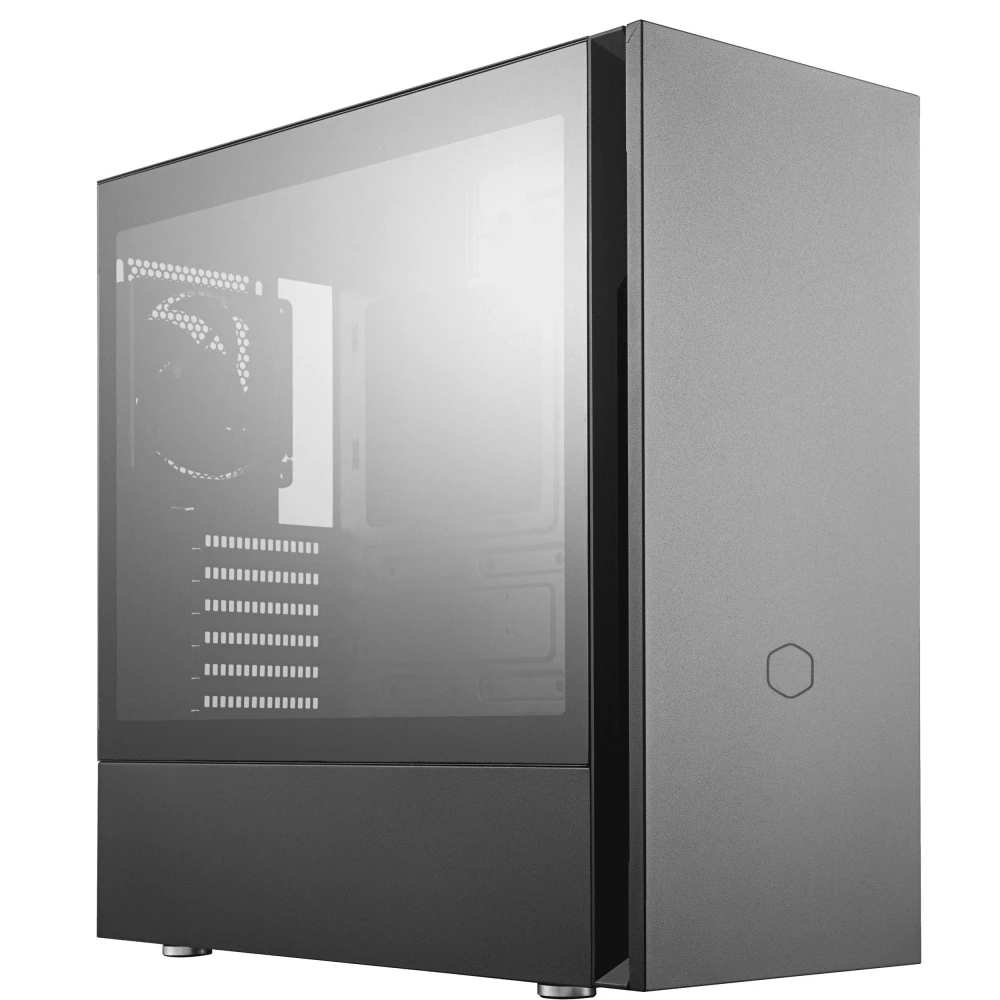
COOLERMASTER Silencio S600 black Glass
not available
Product description
Cooler Master has added a new member to its Silencio series of noise-insulated housings: the Silencio S600 accepts ATX, Mini-ITX and microATX format motherboards. The novelty comes with soundproof side panels, but the noise protection panel on the roof and the front door are also insulated, so that most of the noise generated by the cooling can stay inside the house. A useful extra is that the new computer cases even got a 5.25-inch external expansion slot. If required, the left side panel can also be replaced with a tempered glass panel for both models, as both backs are available on store shelves in two editions.
The opening direction of the front door can be reversed as needed, and the sound dampening sheet on the roof can be removed, so the system can get extra ventilation. By the way, we get two Silencio FP 120 PWM fans from the factory, one of which is located behind the front panel, and the other is located at the back of the case. Inside the housings, there is a motherboard tray with a mounting window, which helps cable management with rubber grommets. Thanks to the two-chamber construction, the power supply unit and part of the data storage can be located in a separate air space.
In the case of the Silencio S600, in addition to the 5.25-inch external expansion slot, there are also four 3.5-inch and five 2.5-inch expansion slots. The frame that accepts classic hard drives can be removed if necessary, and its position can also be changed. The novelty made for microATX and Mini-ITX format motherboards has four PCI expansion slots, and there is plenty of space inside. A maximum of 167 or 166 millimeters can be used for a processor cooler, depending on whether the case has a steel or tempered glass side panel, while expansion cards can manage a maximum of 319 millimeters of space. There is 180 millimeters of space available for the power supply.
Ventilation can be ensured by two 120/140 millimeter air mixers behind the front panel, 1 120 millimeter fan on the back panel, and two 120/140 millimeter fans under the roof panel - in the latter case, the cover plate must be removed, and the ODD frame must not remain in place. In the case of heat-dissipating radiators, a maximum of 280 millimeters can fit behind the front panel if the ODD frame is also removed, while a 240-millimeter radiator can fit under the roof panel, but in this case we can no longer reinstall the ODD frame either. A 120-millimeter heat-dissipating radiator fits on the back panel. Another important addition is that there is roughly 20 millimeters of space behind the motherboard tray for cable management.
In this case, the power supply can be a maximum of 180 millimeters long, and there is 18-26 millimeters of space behind the motherboard tray for the cables. In terms of cooling, the situation is the same as for the smaller model: two 120/140 millimeter fans fit behind the front panel and under the roof panel, and one 120 millimeter fan can be installed on the back panel. Those thinking about a heat-dissipating radiator can install a maximum 280-millimeter version behind the front panel, a maximum 240-millimeter heat-dissipating radiator can fit under the roof plate, which can be a maximum of 35 millimeters high, but the ODD frame must still be removed. The back panel can accommodate a 120-millimeter heat-dissipating radiator.
Of course, the new computer case also received front panel ports, which are now located on the right edge of the roof panel. These include two USB 3.0 Type-A ports, a TRRS-type 3.5 mm Jack Audio connector, and an SD memory card reader - the latter comes in particularly handy in many cases.
PRICE NOTIFICATION
Recommended for you
Similar products
NOTEBOOK SEARCH
OPINIONS
OPINIONS
