
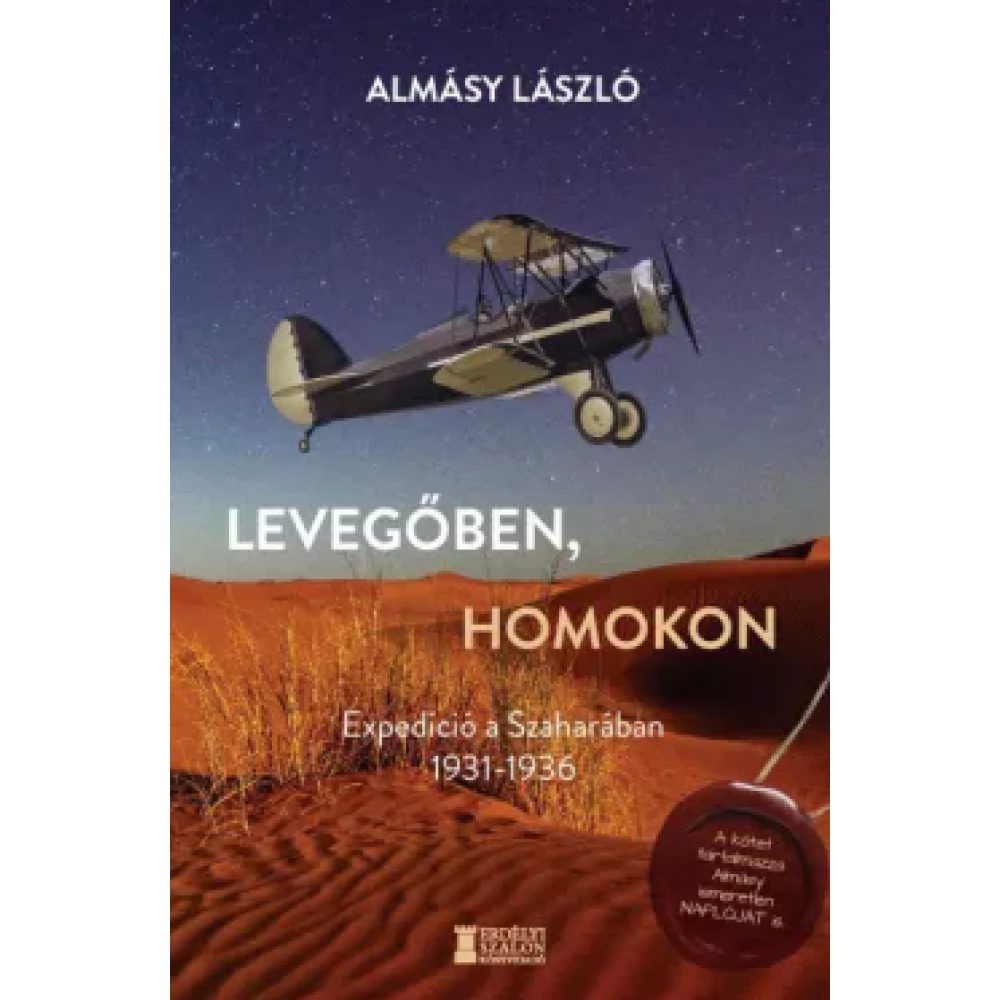
Almásy László - Levegőben homokon
Substitute products
Product description
The English patient: who is neither English nor sick: László Ede Almásy of Zsadányi and Törökszentmiklós, traveler, African researcher and explorer. 1932. he made his first major discovery on 1 May when he found the Zarzura Oasis, his fellow explorers were Sir Robert Clayton, Flight Lieutenant Colonel Penderel and Patrick Clayton. The team discovered the northern main valley of the Gilf Kebir plateau, Wadi Abd el Malik. The team approached Zarzura through the sand dunes, through Egypt. Only after seeing the wheel tracks did the locals believe that Almásy had reached Zarzura through the sea of sand, and gave him the name Abu Ramla (Father of Sand). The news of the discovery spread worldwide, and in 1933, now enjoying the financial support of Universal, Almásy returned to Egypt, to the Gilf Kebír area. The expedition mapped the last unknown places of the Libyan desert. That's when he discovered the swimmers' cave in the desert, with the cave paintings inside. From the depictions of plants and water, he concluded that there had once been intermittent or permanent waters in the place where not a single blade of grass remained. In the rock caves of Ain Dua, about eight hundred animal figures colored in white, red, brown and yellow and human figures depicted in black were found. Hundreds of photographs and sketches were made of the nearly forty rocks and more than twenty caves, and many chests were collected from the stone tools found in the caves. In 1934 and 1935, Almásy mapped the vast sand desert called the Great Sand Sea in the middle of the Sahara. He reported for the first time about the fact that a Berber tribe called Magyar lives on an island of the Nile, near Vádi-Halfa, whose members are said to be II. Descendants of Hungarian prisoners of war and then soldiers captured by Sultan Szolimán's army. The tribe calls itself Hungarian. Excerpt: Recently, a huge white spot appeared on the map of Africa, where the twenty-sixth degree of longitude intersects the Tropic of Cancer. The cartographers filled the empty space by writing in large letters: Libyan Desert. If we divide the Sahara into three parts, the Libyan Desert is the western third. The borders of Egypt, Sudan and the Italian Tripolis run along the imaginary line of longitude and latitude. In reality, however, only the sand borders the rock, nothingness the infinity. The ancient Egyptians once knew the interior of this huge sea of sand and rocks. Later, for centuries no one visited the realm of Death, and the knowledge of the ancient travelers was forgotten. When the Arabs immigrated to Africa from Asia Minor, they had to occupy and get to know their new homeland step by step. They looked at the monuments of the mystical culture of ancient Egypt with superstitious fear and only made slow, groping progress in the unknown country. The relentless desolation of the Libyan desert intimidated the occupying armies, and it took centuries for some reckless scouts to discover the islands of the sand sea, the oases. Those who returned from such a scouting trip told wonderful things. About blue-eyed, blond, but dark-skinned people who live infinitely far away, out in the inaccessible places of the desert, in mysterious oasis cities.
Similar products
NOTEBOOK SEARCH
OPINIONS
OPINIONS
